

 By
By Introduction: What Is a Thalwar?
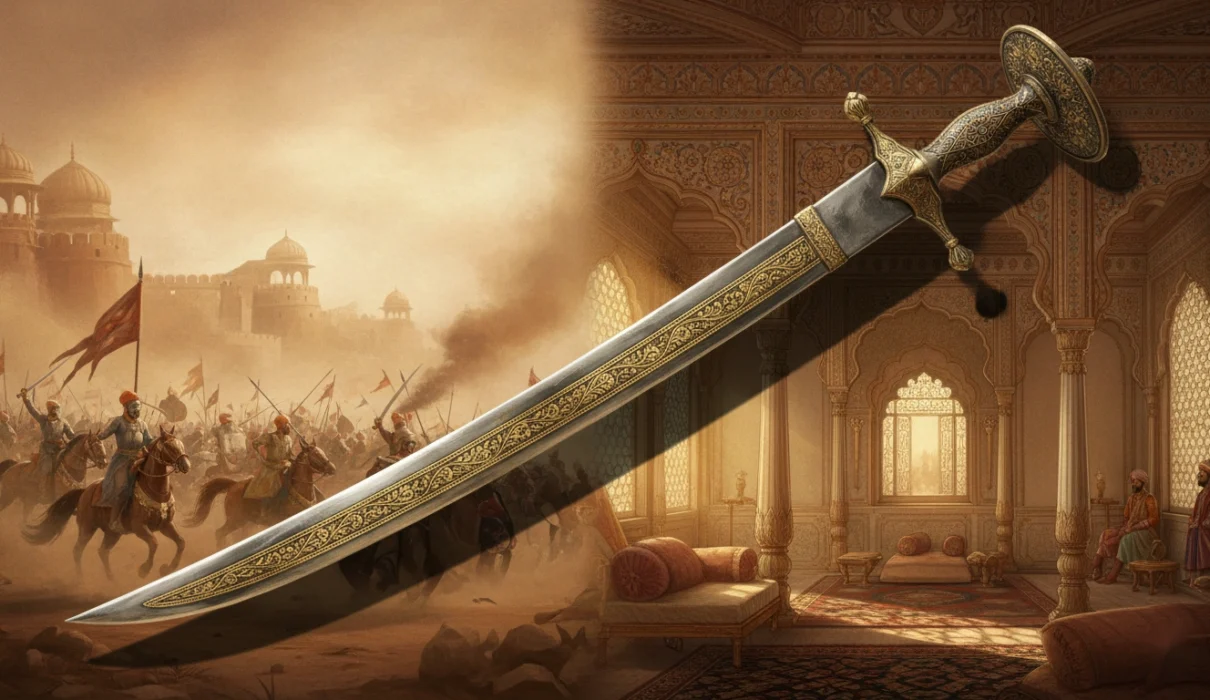
When you hear the word thalwar, you are hearing one of the oldest and most powerful words in the Indian martial vocabulary. A thalwar — also spelled talwar, talwaar, or tulwar — is the traditional curved sword of the Indian subcontinent. It is not merely a weapon. For centuries, it has been a symbol of honour, courage, royalty, and divine protection across Rajput, Mughal, Maratha, and Sikh warrior traditions.
Whether carried by a Mughal emperor into battle, worshipped at a Rajput altar during Dussehra, or worn by a Punjabi groom at his wedding, the thalwar occupies a singular place in Indian history and culture that no other weapon can claim.
This guide covers everything — the meaning, origins, construction, types, famous warriors, cultural significance, legal status, and collector value of the thalwar — making it the most complete resource on this keyword available online.
What Does “Thalwar” Mean? (Etymology and Linguistic Roots)
The word thalwar is a phonetic and regional spelling variant of talwar (तलवार). Both refer to the same object: the traditional curved Indian sabre.
Linguistically, the word traces back to the Sanskrit term taravāri (तरवारि), which literally translates as “one-edged sword.” From Sanskrit, the word evolved and spread across nearly every major language of the Indian subcontinent:
- Hindi and Urdu: तलवार / تلوار (talwar)
- Punjabi: ਤਲਵਾਰ (talwar)
- Gujarati: તલવાર (talvar)
- Marathi: तलवार (talvar)
- Nepali: तरवार (tarawar)
- Bengali: তলোয়ার (toloar)
- Sindhi: ترارِ (trari)
The spelling thalwar is commonly used in North India, Punjab, and parts of the diaspora community — particularly when speaking colloquially or writing phonetically. For the purposes of SEO and modern readership, thalwar and talwar are interchangeable.
Historical Origins of the Thalwar: A Timeline
Pre-Mughal Period (Before 1526)
The roots of the thalwar lie in the Central Asian and Persianate sword traditions that entered India through the waves of Turkic and Afghan invasions during the Delhi Sultanate period (1206–1526). Curved blades derived from the Persian shamshir and the Turkish kilij gradually influenced Indian swordsmiths, who began adapting these forms to local metallurgical traditions and combat requirements.
In this pre-Mughal phase, Indian swords were primarily straight-bladed weapons like the khanda and the pattisa. The curved sabre was a foreign import — but Indian craftsmen were already beginning to fuse the foreign blade geometry with a distinctly native hilt design.
The Mughal Era (1526–1857): The Thalwar Reaches Its Classic Form
The Mughal Empire’s establishment under Babur in 1526 accelerated the thalwar’s rise dramatically. The Mughals, of Turko-Mongol ancestry, brought with them deep traditions of curved sabre warfare. Under successive emperors — Akbar, Jahangir, Shah Jahan, and Aurangzeb — the thalwar became the dominant sword of the Indian subcontinent.
During this era, the thalwar was not only a battlefield weapon but a canvas for extraordinary artistry. Royal workshops produced swords with:
- Wootz steel blades showing distinctive watered patterns (mohr)
- Koftgari decoration — gold and silver inlay work on the hilt and blade
- Hilts studded with diamonds, rubies, and emeralds
- Quranic inscriptions along the fuller (groove) of the blade
One of the most famous surviving examples — preserved at the Laxmi Vilas Palace armoury in Vadodara, Gujarat — is adorned with 275 diamonds and a single large emerald, representing the absolute pinnacle of Mughal craftsmanship.
The Rajput Period: The Thalwar as Sacred Object
For the Rajputs of Rajasthan, the thalwar was more than a weapon — it was a sacred object tied to personal honour. Each Rajput warrior named his sword, treated it as a living companion, and in some traditions, worshipped it as a manifestation of divine power.
Every year during Dussehra (Vijayadashami), Rajputs still perform shastra puja (weapon worship), polishing their thalwars, adorning them with marigold garlands, and offering prayers. To surrender one’s thalwar was considered the ultimate dishonour — equivalent to surrendering one’s soul.
The legendary Rajput warrior Maharana Pratap wielded a thalwar at the famous Battle of Haldighati (1576), where his resistance against the Mughal forces became the defining symbol of Rajput defiance.
The Maratha Period: Speed and Agility
The Marathas, under Chhatrapati Shivaji Maharaj, developed a distinctive relationship with the thalwar. The Bhawani Talwar gifted to Shivaji by the goddess Bhawani according to legend became one of the most iconic swords in Indian history.
Unlike the heavier Mughal and Rajput variants, Maratha thalwars were lighter, shorter, and optimized for guerrilla warfare in the Sahyadri mountain terrain. Speed and agility in the draw-cut were prized over brute force.
The Sikh Tradition: The Thalwar as Spiritual Duty
Under Guru Hargobind and Guru Gobind Singh, the sword became central to Sikh philosophy through the concept of miri-piri — the balance of temporal and spiritual power. The thalwar was incorporated into the martial art of Gatka, still practised at religious festivals and cultural events today.
The kirpan — the ceremonial dagger mandatory for baptized Sikhs — is the modern descendant of this tradition. Punjabi thalwars from this period were often richly engraved with Gurmukhi script and silver hilts.
Anatomy of a Thalwar: Understanding Its Design
Understanding the physical construction of a thalwar is essential to appreciating why it was so effective in battle.
The Blade
- Shape: Curved single-edged blade, typically with a moderate curve of 10–15 degrees — less radical than the Persian shamshir but more curved than a straight sword
- Length: Usually 70–85 cm (approximately 28–33 inches)
- Weight: Approximately 1–1.2 kg (2.2–2.6 lbs)
- Material: High-carbon steel; premium examples used wootz steel (also called Damascus steel), recognizable by its distinctive watered or moiré patterning
- Fuller (groove): A longitudinal groove running along the blade to reduce weight without sacrificing structural integrity
- Tip geometry: Many thalwars show a widening of the blade near the tip, enhancing the force of a slashing draw-cut
The Hilt (Handle Assembly)
The thalwar hilt is its most distinctive feature — described in scholarship as the Indo-Muslim hilt or disc hilt:
- Disc pommel: A flat, disc-shaped flange at the base of the grip. This is the single most recognizable feature of a thalwar. It prevents the sword from slipping forward during a draw-cut and creates a natural wrist lock.
- Grip: Short and tight, constraining the wrist into the optimal cutting angle
- Quillons (cross-guard): Simple horizontal guards, sometimes with a slender knuckle bow
- Langets: Two small extensions from the guard that secure the hilt in the scabbard
- Pommel spike: A short spike projecting from the centre of the disc, sometimes pierced for a wrist cord
The hilt was most commonly made of iron, though brass, silver, and gold hilts exist. The blade was secured to the tang using lac resin derived from the peepal tree — an adhesive so strong that many 400-year-old swords survive with their original hilts intact.
The Scabbard (Miyaan)
Traditional thalwar scabbards were made of soft wood covered in leather or velvet, designed to protect the blade’s edge without dulling it. Princely scabbards were covered in gold-stamped leather, enamelled metalwork, or velvet embroidered with gold thread.
Types and Regional Variants of the Thalwar
The thalwar was never a single, standardized object. Regional traditions, combat requirements, and artistic preferences produced numerous distinct variants:
1. Rajput Thalwar
Slightly longer blade, elaborate hilt with local clan motifs, gold and enamel decoration. Often named and treated as heirloom objects passed down through generations.
2. Mughal Court Thalwar
Finest craftsmanship of any variant. Wootz blades with koftgari gold inlay, gemstone-encrusted hilts, Quranic inscriptions. As much art object as weapon.
3. Maratha Thalwar
Lighter and shorter. Optimized for swift guerrilla combat. Less decorative than Mughal examples but exceptionally sharp and well-balanced.
4. Sikh/Punjabi Thalwar
Reinforced langets and thicker quillons for sustained battlefield use. Often engraved with Gurmukhi script. Longer handle variants exist for two-handed grip.
5. Sirohi
A sub-variant characterized by an only slightly curved blade. Named after the city of Sirohi in Rajasthan, historically famous for its sword-making tradition.
6. Tegha
A variant with a particularly wide, heavy blade — sometimes referred to as an executioner’s sword, though evidence for this specific use is limited. More common as a ceremonial weapon.
7. Sosun Patta (Lily Leaf Sword)
A related Indo-Muslim sword sharing the disc-pommel hilt but featuring a forward-curving yatagan-type blade. The curve is concentrated in the final third of the blade, resembling a lily leaf.
8. Zulfiqar
A double-tipped variant associated with Islamic tradition, featuring a forked blade tip. Rare and primarily ceremonial.
9. Firangi
A hybrid variant using a European (usually Portuguese or Dutch) straight blade fitted into a traditional Indian disc-hilt. “Firangi” means “foreigner” in Hindi/Urdu — the name itself reflects the sword’s hybrid identity.
Thalwar vs. Related Indian Swords: A Comparison
| Sword | Blade Type | Edge | Primary Use | Notable Association |
|---|---|---|---|---|
| Thalwar/Talwar | Curved sabre | Single | Cavalry, infantry | Mughal, Rajput, Maratha, Sikh |
| Khanda | Straight, broad | Double | Infantry, ceremonial | Sikh religion, Rajput |
| Katar | Short, triangular | Double | Close combat, stabbing | Maratha, Rajput nobility |
| Pata | Straight, gauntlet | Double | Infantry | Maratha warriors |
| Urumi | Flexible whip-blade | Single | Martial art | Kerala Kalaripayattu |
| Kukri | Forward-curved | Single | Utility, combat | Gurkha, Nepal |
The Thalwar in Combat: How It Was Actually Used
The thalwar’s design was engineered for a highly specific and devastatingly effective fighting system known as the draw-cut (or pulling cut).
Unlike European sabres, which were used with slashing and thrusting motions, the thalwar’s tight hilt locked the wrist at a fixed angle. This constrained grip directed all cutting energy into a single pulling motion along the blade — maximizing tissue damage with minimum effort.
Key combat characteristics:
- Cavalry superiority: A mounted warrior could ride close to an enemy and perform a single, sweeping draw-cut that devastated opponents without embedding the blade. This was critical — a stuck blade on horseback meant death.
- Draw-cut mechanics: The blade entered the target at an angle and was pulled backward simultaneously, causing a slicing wound far deeper than a simple chop.
- Limited thrusting: The disc pommel prevented full extension for a forward thrust, though the moderate blade curve (unlike the more extreme shamshir) still allowed some thrusting capability.
- Footwork: Thalwar fighting systems emphasized diagonal footwork, using the body’s rotation to amplify cutting force.
These techniques survive today in Gatka (Sikh martial art) and have been reconstructed by practitioners of Historical Indian Martial Arts (HIMA).
Cultural Significance: The Thalwar Beyond the Battlefield
Weddings and Rituals
In Rajput, Punjabi, and Maratha wedding traditions, the groom carries a ceremonial thalwar — a practice that continues widely today. The sword symbolizes his commitment to protect his family and uphold ancestral honour. At many North Indian weddings, the thalwar is as central to the ceremony as the wedding ring is in Western culture.
Dussehra and Shastra Puja
Every year at Dussehra (Vijayadashami), millions of Indians — particularly from Kshatriya and Rajput communities — perform shastra puja: the ritual worship of weapons. Thalwars are cleaned, oiled, adorned with marigolds, and offered prayers. This tradition bridges the ancient world of warrior culture and the contemporary practice of religious devotion.
Folklore and Literature
The thalwar appears throughout Indian folklore, mythology, and literature as the instrument of heroic justice. In these stories, it functions not as a tool of violence but as an extension of the hero’s dharma — the sword cuts through evil just as wisdom cuts through ignorance.
In Urdu and Hindi poetry, the talwar/thalwar is a recurring metaphor. Mirza Ghalib wrote: “is sādgī pe kaun na mar jāe ai Khudā / laḌte haiñ aur hath mein talwar bhī nahīñ” — a wry lament about fighting without even a sword, used metaphorically for helplessness in love.
Museums and Collections
Major international museums hold significant thalwar collections, including:
- The Metropolitan Museum of Art, New York — extensive collection of Mughal and Rajput arms
- The Victoria and Albert Museum, London — Mughal court weapons and armour
- The National Museum of India, New Delhi — comprehensive Indian martial heritage collection
- The Laxmi Vilas Palace Armoury, Vadodara — one of the finest private royal armouries in India
The Craft of the Thalwar: Materials and Making
Wootz Steel: India’s Metallurgical Marvel
The finest thalwars were forged from wootz steel — a crucible steel produced in South India from at least the 3rd century BCE. Wootz is characterized by its exceptionally high carbon content (1.5–2%), which gives it superior hardness and edge retention compared to European iron.
The distinctive watered pattern (mohr) visible on wootz blades — resembling flowing water or wood grain — results from the segregation of carbides during the steel’s slow cooling process. This is not a surface treatment but a structural property of the metal itself.
Indian wootz was exported across the world: Persian shamshirs, Ottoman kilij, and Arab saifs frequently used Indian-made wootz blades in their construction.
Koftgari: The Art of Gold Inlay
Premium thalwars were decorated using koftgari — a technique of hammering fine gold or silver wire into crosshatched grooves cut into the steel. The result is intricate geometric and floral patterns that appear to float on the dark steel surface. Koftgari is still practised in Rajasthan today, though few artisans remain who work at the historic level of quality.
Lac Adhesive and Hilt Assembly
The hilt was secured to the blade tang using lac resin (from the peepal or banyan tree), heated until molten and poured into the hilt cavity around the tang. On cooling, it bonds with remarkable strength — strong enough that many 400-year-old thalwars have never needed re-hilting.
Related Topics: The Thalwar’s Place in a Wider World
The Thalwar and the British Sabre
Military historians have noted striking similarities between some thalwar blade profiles and the British Pattern 1796 Light Cavalry Sabre — a sword used throughout the Napoleonic Wars. The widening near the tip and the increasing curvature of the distal blade are features shared between both. Some scholars suggest the thalwar may have directly influenced British cavalry sword design through colonial contact.
The Thalwar in Shiite Ritual
The thalwar occupies a unique religious dimension in Shiite Islam. During Muharram commemorations on Ashura (the 10th of Muharram), some communities practise talwar zani — a form of self-flagellation using the flat of a sword — as an expression of grief for the martyrdom of Imam Hussain at Karbala. This practice connects the sword to the most solemn moment in the Shiite religious calendar.
Thalwar in Indian Cinema
From the epic battles of Mughal-E-Azam (1960) to contemporary historical films like Bajirao Mastani (2015) and Padmaavat (2018), the thalwar is the default weapon of Indian historical cinema. Its visual drama — the flash of the curved blade, the distinctive disc pommel, the ornate koftgari hilt — makes it immediately recognizable as a symbol of India’s warrior past.
Buying, Collecting, and Legal Status
Collector Market
Authentic antique thalwars are increasingly sought-after by international collectors. Approximate market values:
- Plain 18th–19th century military-grade thalwar: ₹60,000 – ₹2,00,000 (£600–£2,500)
- Decorated koftgari examples with provenance: ₹5,00,000 – ₹15,00,000 (£5,000–£18,000)
- Royal commission pieces with gemstone hilts: ₹30,00,000+ (£30,000+)
- Museum-quality wootz blades with documented royal provenance: £75,000+
Authenticity: What to Look For
- Wootz patterning: Genuine wootz shows dendritic (tree-branch) or watered patterns visible under magnification — distinct from acid-etched fakes
- Hilt construction: Authentic early examples use pinned or lac-secured tangs, not welded or threaded modern fittings
- Natural patina: Genuine age produces a specific grey-black patina distinct from chemically accelerated artificial aging
- Weight and balance: Authentic thalwars have a very specific balance point — top-heavy fakes feel wrong in the hand immediately
Legal Status in India
Under the Arms Act, 1959 and the Arms Rules, 2016, the possession of swords in India is regulated. Key points:
- Swords above a certain blade length generally require a licence for public carry
- Display and private collection in the home is widely practised and generally not prosecuted
- Ceremonial use (weddings, religious events) is socially accepted and legally tolerated
- Export of antique weapons (pre-1947) requires permits under the Antiquities and Art Treasures Act
Always consult a legal professional for jurisdiction-specific advice before purchasing or transporting a thalwar.
Frequently Asked Questions (FAQs)
What is the difference between thalwar and talwar?
Thalwar is a phonetic spelling variant of talwar, also written as talwaar or tulwar. All refer to the same traditional curved Indian sword. “Thalwar” is commonly used in North India and Punjab in informal speech and writing, while “talwar” is the standard dictionary form. For search purposes, Google treats them as closely related terms.
What does thalwar mean in Hindi?
In Hindi (and Punjabi, Urdu, Gujarati, Marathi, and Nepali), thalwar/talwar (तलवार) means “sword.” It derives from the Sanskrit taravāri, meaning “one-edged sword,” and is the everyday word for any sword in most North Indian languages.
Who used the thalwar historically?
The thalwar was used across a wide range of Indian warrior communities: Mughal emperors and their cavalry, Rajput kings and clan warriors, Maratha infantry and cavalry under Shivaji and the Peshwas, Sikh warriors trained in Gatka, Afghan and Turkic armies, and later by Indian soldiers under British colonial service.
What makes the thalwar different from a regular sword?
Several features distinguish the thalwar from other swords: its moderate curved blade (less curved than a shamshir), its unique all-metal Indo-Muslim disc-pommel hilt, its tight grip that locks the wrist for the draw-cut technique, and the use of Indian lac resin as hilt adhesive. No other sword in the world combines all these elements.
What is wootz steel and why does it matter for thalwars?
Wootz steel is a form of crucible steel produced in South India since at least the 3rd century BCE. It has an unusually high carbon content that produces exceptional hardness, toughness, and edge retention. Its distinctive watered or moiré patterning is not decorative — it is a visible result of the steel’s microstructure. The finest thalwar blades were made from wootz, and genuine wootz thalwars are among the most valuable antique weapons in the world.
Is it legal to own a thalwar in India?
Private possession of a thalwar for display or collection purposes in the home is widely practised in India. Public carry and transport require licensing under the Arms Act, 1959. Ceremonial use at weddings and religious events is socially and legally accepted in most contexts. Export of antique thalwars requires government permits.
How do I identify an authentic antique thalwar?
Look for: genuine wootz patterning (dendritic patterns visible under magnification), lac resin in the hilt socket, natural grey-black age patina on the steel, period-appropriate construction methods (pinned tang, hand-filed quillons), and hand-worked koftgari decoration on valuable examples. Seek expert appraisal before any significant purchase.
What is the thalwar’s connection to Sikh culture?
The thalwar is deeply embedded in Sikh martial tradition. Under Guru Hargobind and Guru Gobind Singh, the sword became a symbol of the sant-sipahi (saint-soldier) ideal. Thalwar fighting was systematized into Gatka, the Sikh martial art still practised at festivals. The kirpan — one of the Five Ks mandatory for baptized Sikhs — is the direct ceremonial descendant of the thalwar tradition.
What is the Bhawani Talwar?
The Bhawani Talwar is the legendary sword associated with Maratha king Chhatrapati Shivaji Maharaj. According to tradition, the goddess Bhawani personally gifted this sword to Shivaji, blessing his campaigns. It has become one of the most powerful symbols of Maratha identity and resistance. The sword is revered as a divine weapon rather than merely a martial tool.
Can I buy a thalwar online in India?
Yes. Both decorative replicas and certified antique thalwars are available through specialist dealers, auction houses, and handicraft sellers in India. Notable sources include traditional arms merchants in Jaipur, Jodhpur, Delhi, and Amritsar. Online marketplaces also carry decorative replicas, though serious collectors should always buy from reputable dealers who provide provenance documentation.
Conclusion: Why the Thalwar Still Matters
The thalwar is not a relic. It is a living symbol — worn at weddings, worshipped at altars, practised in martial arts dojos, displayed in museums, and sought by collectors on six continents. Its distinctive curved blade and disc-pommel hilt are immediately recognizable as expressions of Indian identity that transcend any single religion, caste, or region.
From the Sanskrit roots of its name to the wootz steel of its blade, from the koftgari gold of its hilt to the lac resin that holds it together — every element of the thalwar is a chapter in the story of Indian civilization. To hold one is to hold centuries.
Whether you are a historian, a collector, a martial artist, a groom preparing for your wedding, or simply someone who wants to understand one of the world’s great sword traditions — the thalwar deserves your attention.
This article was researched using primary historical sources, peer-reviewed scholarship on Indian arms and armour, and expert collector knowledge. Sources include Wikipedia’s talwar entry (citing Pant’s Indian Arms and Armour, 1980), Discovery UK’s talwar historical guide, Mandarin Mansion’s Indian sword glossary, and Seven Swords UK’s comprehensive talwar study.
