

 By
By TL;DR
A battle-ready sword is more than just sharp steel. Real functional swords are built with the right tang construction, heat treatment, balance, blade geometry, materials, and durability testing. These six factors separate real swords from decorative wall hangers.
Introduction
Many swords look impressive, but not every sword is made for real use. Some are only decorative, while others are built to handle cutting practice, training, or combat-style stress. The term “battle ready” is often used in marketing, but many people do not fully understand what it actually means.
A true battle-ready sword is designed to survive force, impact, and repeated use without bending, loosening, or breaking. It combines proper materials, construction, balance, and craftsmanship.
Here are the six most important things that make a sword truly battle ready.
1. Full Tang Construction
The tang is the hidden part of the blade that extends into the handle. This is one of the most important parts of any sword.
A battle-ready sword almost always uses a full tang design. That means the steel from the blade continues deeply through the grip and connects securely to the pommel.
Why It Matters
When a sword strikes a target, huge amounts of force travel through the blade and into the handle. If the tang is weak, the sword can fail completely.
A strong tang helps with:
- Durability
- Balance
- Shock absorption
- Structural strength
Decorative swords often use a rat-tail tang, which is a thin welded rod attached to the blade. These are unsafe for cutting because they can snap under pressure.
Signs of a Good Tang
- Peened pommel or secure threaded construction
- No rattling in the handle
- Solid grip alignment
- Proper weight distribution
Without a strong tang, a sword cannot truly be battle ready.
2. Proper Heat Treatment
Heat treatment is what gives a sword the correct balance between hardness and flexibility.
After forging, the blade is heated and cooled carefully to change the structure of the steel. This process determines whether the sword becomes durable or fragile.
Why Heat Treatment Matters
A blade that is too hard may chip or crack. A blade that is too soft may bend permanently.
A properly heat-treated sword should:
- Flex slightly under pressure
- Return to shape
- Hold a sharp edge
- Resist breaking
This is one reason historical swordsmiths were highly respected. Heat treatment required skill and experience.
Common Types
Differential Hardening
Common in Japanese swords like katanas.
- Hard edge for sharpness
- Softer spine for flexibility
Through Hardening
Hardness remains more even across the blade.
- Strong flexibility
- Better shock resistance
- Easier maintenance
Both methods can create excellent battle-ready swords when done properly.
3. High-Quality Steel
Steel quality plays a major role in performance.
A battle-ready sword needs steel that can handle impact without becoming brittle or weak.
Common Functional Sword Steels
1060 Carbon Steel
A popular balance of toughness and flexibility.
1095 Carbon Steel
Harder steel with strong edge retention.
5160 Spring Steel
Excellent flexibility and durability.
T10 Steel
Often used in high-performance katanas.
These steels are commonly trusted because they handle stress well.
Steels to Avoid
Cheap decorative swords often use:
- Low-grade stainless steel
- Unknown alloys
- Soft metal blends
These may look shiny, but they are usually unsafe for real cutting.
4. Proper Blade Geometry
Blade geometry means the overall shape and structure of the blade.
This includes:
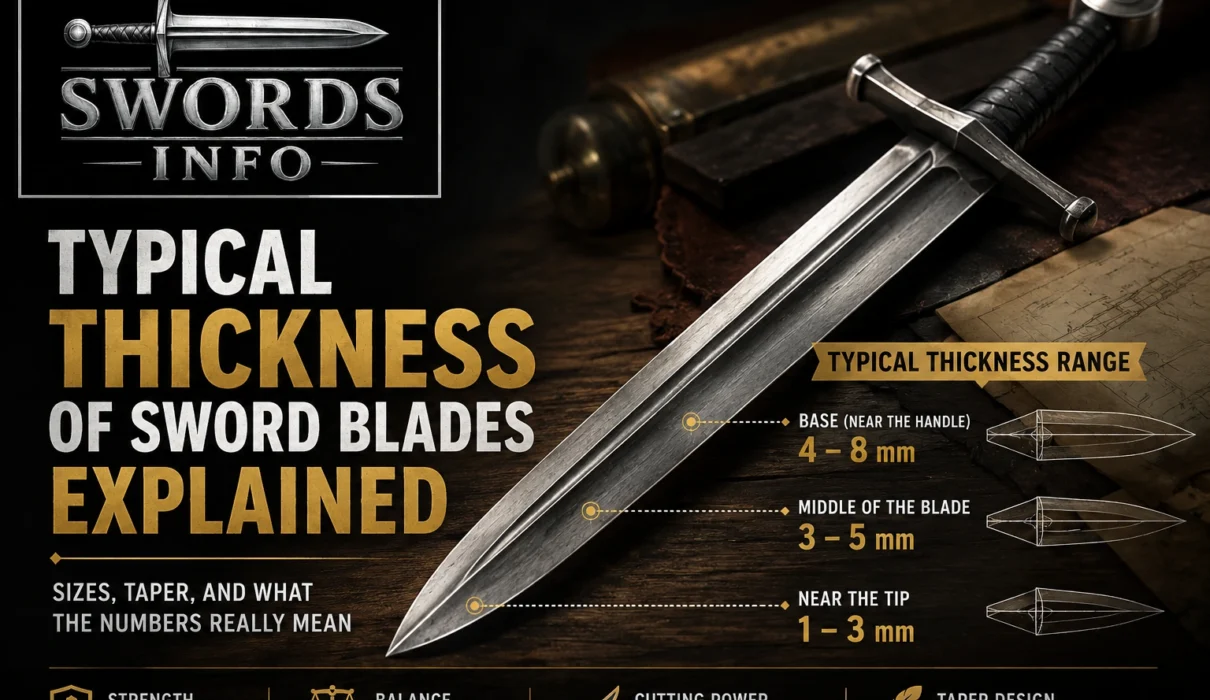
- Thickness
- Edge shape
- Blade width
- Distal taper
- Cross-section
A battle-ready sword needs geometry designed for performance, not appearance.
Distal Taper
One of the most important features is distal taper, where the blade becomes thinner toward the tip.
This improves:
- Speed
- Balance
- Control
- Cutting efficiency
Without taper, a sword feels heavy and awkward.
Edge Geometry
Different swords use different edge designs.
- Thin edges cut better
- Thicker edges improve durability
- Convex edges resist damage well
Good blade geometry allows the sword to perform efficiently without becoming fragile.
5. Good Balance and Weight Distribution
Movies often show swords as giant heavy weapons, but real swords were surprisingly balanced.
A battle-ready sword should feel controlled in the hand, not exhausting.
Why Balance Matters
Poor balance makes a sword:
- Slow
- Hard to control
- Tiring to swing
Good balance allows:
- Faster movement
- Better recovery between strikes
- Improved accuracy
- Reduced fatigue
Most historical swords weighed far less than people expect.
Average Weight Range
- Arming sword: around 1–1.5 kg
- Longsword: around 1.2–1.8 kg
- Katana: around 1–1.4 kg
Balance is often more important than raw weight.
Point of Balance
The point of balance is usually a few inches forward from the guard.
This helps combine:
- Cutting power
- Maneuverability
- Control
A well-balanced sword feels alive in the hand.
6. Real Durability Testing
A true battle-ready sword should be tested before use.
Good manufacturers test swords for:
- Flexibility
- Edge retention
- Structural strength
- Handle security
This helps ensure the sword can survive repeated impact safely.
Common Functional Tests
Flex Test
The blade bends and returns to shape.
Cutting Test
Used on materials like tatami mats or bottles.
Impact Resistance
Checks how the blade handles stress.
Historical swords were tested through real combat. Modern battle-ready swords try to follow similar durability standards.
Decorative vs Battle-Ready Swords
Many people confuse decorative swords with functional swords.
Decorative swords are made mainly for display. They may look attractive but are not designed for impact.
Decorative Sword Problems
- Weak tangs
- Poor steel quality
- No heat treatment
- Incorrect balance
- Brittle construction
Using decorative swords for cutting can be dangerous.
Battle-Ready Sword Features
A real functional sword usually includes:
- Full tang construction
- Carbon steel blade
- Proper heat treatment
- Sharpened edge
- Durable fittings
- Good balance
These features allow safe and effective use.
Common Myths About Battle-Ready Swords
“Heavy swords are stronger”
Not true. Too much weight makes a sword slower and less practical.
“Stainless steel swords are best”
Most stainless steels are too brittle for long functional blades.
“Sharpness alone makes a sword battle ready”
A razor-sharp blade with poor construction is still unsafe.
“All expensive swords are battle ready”
Price alone does not guarantee quality. Construction matters more.
Final Thoughts
A battle-ready sword is not defined by appearance alone. Real functionality comes from proper engineering and craftsmanship.
The six most important features are:
- Full tang construction
- Proper heat treatment
- High-quality steel
- Good blade geometry
- Correct balance
- Durability testing
When these elements work together, a sword becomes strong, safe, and reliable.
Whether you are collecting, training, or simply learning about historical weapons, understanding these features helps you recognize the difference between a real functional sword and a decorative replica.
References
- Ewart Oakeshott – The Sword in the Age of Chivalry
- Alan Williams – The Knight and the Blast Furnace
- John Clements – Historical European Martial Arts research
- Royal Armouries Museum – Arms and Armor studies
- Metropolitan Museum of Art – Historical sword collections
