

 By
By Table of Contents
TL;DR
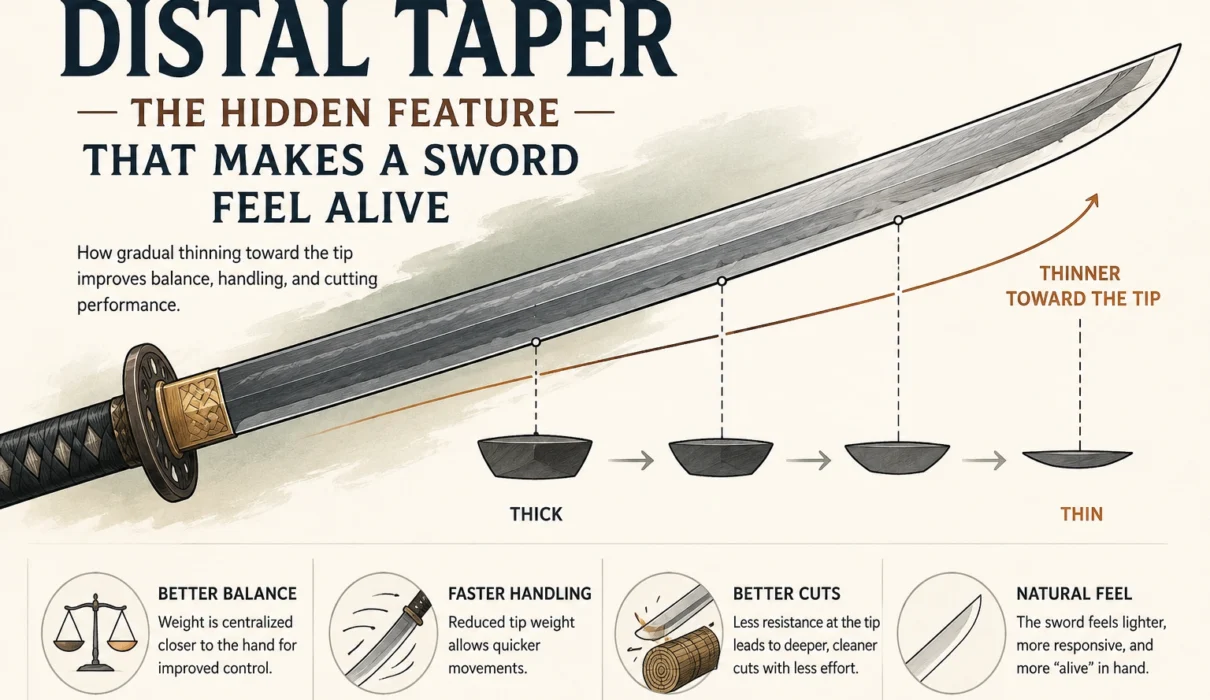
Distal taper is the gradual reduction of blade thickness from the guard toward the tip of a sword. It helps improve balance, speed, control, and cutting performance while reducing unnecessary weight. Good distal taper can make a sword feel fast and responsive instead of heavy and awkward.
What Is Distal Taper?
Distal taper is one of the most important parts of sword design, yet many beginners never hear about it when buying a sword.
In simple terms, distal taper means the blade becomes thinner as it moves from the hilt toward the tip. The change is gradual, not sudden. A sword may start thick near the guard for strength and durability, then slowly reduce in thickness toward the end of the blade.
This design was used in many historical swords because it improves handling and makes the weapon more efficient in combat.
A sword without proper distal taper often feels overly heavy, slow, and difficult to control. On the other hand, a blade with well-designed distal taper usually feels lively and balanced in the hand.
Whether you are buying a medieval longsword, katana, arming sword, saber, or even a modern replica, understanding distal taper can help you judge the quality of the blade.
Why Distal Taper Matters
Many people think sword performance depends only on sharpness or steel quality. Those things matter, but geometry is equally important.
Distal taper changes how a sword moves, cuts, and balances.
Here are the main reasons why distal taper is important.
Better Balance
One of the biggest benefits of distal taper is improved balance.
If the entire blade stayed equally thick from guard to tip, too much weight would remain toward the front of the sword. That would make the weapon feel tip-heavy and tiring during extended use.
By reducing thickness toward the tip, swordsmiths remove unnecessary weight while still keeping enough strength where needed.
This helps move the center of balance closer to the user’s hand, making the sword easier to maneuver.
Faster Handling
A sword with good distal taper usually feels faster.
Less mass near the tip means the blade changes direction more easily. This is extremely important in fencing, sparring, and historical combat.
Quick recovery after a strike can decide the outcome of a fight.
Historical European swords often used strong distal taper because knights needed weapons that could move quickly while still delivering powerful cuts.
Improved Cutting Performance
Distal taper also helps cutting ability.
A blade that becomes thinner toward the tip can move through targets more efficiently. The reduced mass at the front lowers drag while keeping enough structural support near the base.
This creates a balance between power and speed.
Different sword styles use different taper profiles depending on their intended purpose.
Better Thrusting Ability
Many thrust-oriented swords use distal taper to support strong point control.
As the blade narrows in thickness, the tip can become more precise and agile. This improves penetration during thrusts.
Weapons designed for armored combat often relied on this feature.
Reduced Fatigue
A heavy sword becomes exhausting after repeated swings.
Proper distal taper reduces overall weight without sacrificing too much durability. This allows longer use with less strain on the arms and wrists.
That is one reason why well-made historical swords often feel lighter than modern decorative replicas.
Distal Taper vs Profile Taper
Beginners often confuse distal taper with profile taper.
These are not the same thing.
Distal Taper
Distal taper refers to the reduction in blade thickness.
Example:
- 6 mm thick near the guard
- 4 mm in the middle
- 2.5 mm near the tip
Profile Taper
Profile taper refers to the reduction in blade width.
Example:
- Wide near the guard
- Narrower toward the tip
A sword can have one type of taper, both types, or very little taper at all.
Many high-quality historical swords use both distal and profile taper together for optimal handling.
How Distal Taper Affects Sword Types
Different swords use distal taper in different ways.
Medieval Longswords
Many European longswords feature noticeable distal taper.
These swords needed to balance cutting power with agility. A thick base gave strength during parrying, while the thinner tip improved handling and thrusting.
Well-made longswords often feel surprisingly fast because of efficient blade geometry.
Arming Swords
Single-handed arming swords also commonly used distal taper.
Since these weapons were carried daily by knights and soldiers, weight control was extremely important.
A properly tapered arming sword could remain responsive while still delivering effective cuts.
Katanas
Traditional Japanese katanas generally use less dramatic distal taper compared to many European swords.
However, taper still exists in many historical blades.
The geometry of a katana focuses heavily on cutting performance and edge alignment.
Sabers
Curved sabers often rely on balance and speed.
Distal taper helps keep the blade agile during slashing attacks from horseback or fast movement.
Rapiers
Rapiers are highly thrust-focused weapons.
Many historical rapiers use strong tapering to create excellent point control and quick handling.
Historical Swordsmiths Understood Distal Taper
- Distal taper is not a modern invention.
- Historical swordsmiths understood blade dynamics through experience and experimentation.
- Museum collections show that many surviving medieval and Renaissance swords feature carefully planned taper patterns.
- This proves that historical makers were highly skilled engineers even without modern technology.
- Modern collectors sometimes assume ancient swords were crude or heavy, but many authentic historical weapons are refined and extremely well-balanced.
Distal Taper in Modern Replica Swords
Today, distal taper is one of the easiest ways to separate a real functional sword from a cheap decorative replica.
Low-quality swords often have little or no distal taper because it is cheaper and easier to manufacture flat blades with uniform thickness.
Unfortunately, this creates swords that feel clumsy and unrealistic.
A quality functional sword usually includes proper taper because reputable makers understand historical blade dynamics.
When shopping for a sword, always check:
- Blade thickness near the guard
- Blade thickness near the tip
- Overall weight
- Point of balance
- Intended use
These details reveal far more about handling than marketing descriptions.
How to Measure Distal Taper
You can measure distal taper using calipers.
Measure the blade thickness at several points:
- Near the guard
- Mid-blade
- Near the tip
Example:
| Blade Section | Thickness |
|---|---|
| Base | 6 mm |
| Middle | 4.5 mm |
| Near Tip | 3 mm |
This shows a clear distal taper.
Collectors and reviewers often discuss taper measurements because they strongly affect handling characteristics.
Is More Distal Taper Always Better?
Not necessarily.
Too much distal taper can weaken a blade.
The ideal amount depends on the sword’s purpose.
A heavy cutting sword may need more thickness throughout the blade for durability. A thrust-oriented sword may benefit from more aggressive tapering.
Good sword design is about balance between:
- Strength
- Weight
- Flexibility
- Speed
- Intended combat style
This is why different historical cultures developed different blade geometries.
Common Myths About Distal Taper
Myth 1: Heavy Swords Are More Powerful
Many people believe heavier swords are automatically better.
In reality, proper balance matters more than raw weight.
A well-tapered sword can deliver powerful cuts while remaining fast and controllable.
Myth 2: Distal Taper Is Only for Expensive Swords
While premium swords often have better tapering, many affordable functional swords also include good blade geometry.
Understanding distal taper helps buyers avoid poor-quality decorative weapons.
Myth 3: All Historical Swords Were Heavy
Most real historical swords were lighter than many modern replicas.
Efficient tapering played a major role in that.
Distal Taper and Sword Safety
Proper blade geometry also affects safety.
A badly designed sword with poor weight distribution can become harder to control during cutting practice or sparring.
Functional swords should always come from trusted makers who understand historical design principles.
Never use decorative stainless steel swords for cutting practice.
What Collectors Should Look For
If you are buying a functional sword, distal taper should absolutely matter.
Ask these questions before purchasing:
- Does the blade thickness change gradually?
- Is the sword designed after historical examples?
- Does the maker publish blade measurements?
- Is the handling described as balanced and responsive?
- Is the sword intended for decoration or actual use?
Good manufacturers usually provide detailed specifications.
Why Distal Taper Matters More Than Many Beginners Realize
New collectors often focus only on appearance.
But experienced enthusiasts know that handling defines the true quality of a sword.
Two swords can look almost identical while feeling completely different in the hand.
One may feel slow and awkward.
The other may feel alive, responsive, and precise.
Very often, distal taper is one of the reasons.
Final Thoughts
Distal taper is one of the hidden secrets behind historical sword performance. It affects balance, speed, cutting ability, thrusting control, and overall handling. A properly tapered sword feels lighter, faster, and more natural to use. Whether you are a collector, martial artist, reenactor, or beginner buyer, understanding distal taper will help you make smarter decisions. The next time you hold a sword, do not look only at the blade length or sharpness. Pay attention to how the blade thickness changes from base to tip. That small detail can completely change how a sword performs.
FAQs About Distal Taper
What does distal taper mean?
Distal taper means the gradual reduction in blade thickness from the hilt toward the tip of a sword.
Why is distal taper important?
Distal taper improves balance, handling, speed, and overall sword performance.
Do all swords have distal taper?
No. Some decorative or low-quality swords have very little taper or none at all.
Is distal taper found in katanas?
Yes, many historical katanas have some degree of distal taper, though it is often less dramatic than in certain European swords.
Does distal taper make a sword weaker?
Not if designed properly. Good distal taper removes unnecessary weight while maintaining enough strength.
References
- Ewart Oakeshott, The Sword in the Age of Chivalry
- Ewart Oakeshott, Records of the Medieval Sword
- Richard F. Burton, The Book of the Sword
- Peter Johnsson research on historical sword dynamics
- Royal Armouries historical sword studies
- Albion Swords educational articles on sword geometry
