

 By
By Table of Contents
Blade thickness is one of the most important parts of a sword, but it is often ignored. Many people look at length, sharpness, or design, but thickness plays a big role in how a sword performs. It affects strength, balance, cutting ability, and even safety. Whether you are a collector, buyer, or just curious, understanding this helps you judge a sword better.
What Does Blade Thickness Really Mean?
When we talk about thickness, we are not talking about the sharp edge. The cutting edge of any sword is always very thin. Thickness mainly refers to the spine, which is the back of the blade.
This spine gives the sword its structure. Think of it like the backbone. Without proper thickness at the spine, the blade would bend too easily or even break under pressure.
At the same time, if the spine is too thick, the sword becomes heavy and slow. That is why sword makers carefully control thickness across the blade.
Typical Thickness Range
Most real, functional swords follow a common range:
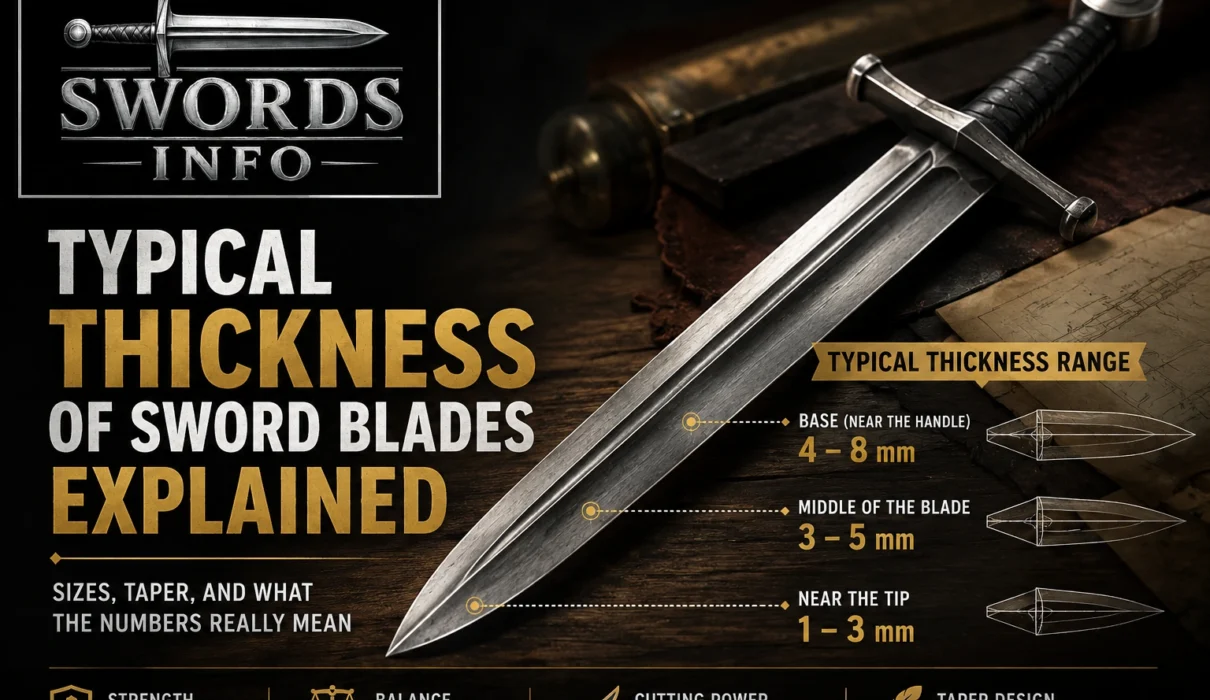
- Base (near the handle): 4 mm to 8 mm
- Middle of the blade: 3 mm to 5 mm
- Near the tip: 1 mm to 3 mm
This gradual reduction is not random. It is a key design feature that improves performance. You will rarely find a well-made sword that has the same thickness from base to tip.
Distal Taper: The Secret Behind Good Swords
The gradual thinning of the blade is called distal taper. This is one of the most important features in sword design.
Instead of keeping the blade thick all the way through, sword makers reduce thickness as the blade moves toward the tip. This has several benefits:
- Better balance – The sword feels lighter and easier to control
- Faster movement – Less weight at the tip means quicker swings
- Improved cutting – The blade moves more smoothly through targets
- Reduced fatigue – Easier to use for longer periods
Without distal taper, a sword would feel clumsy. Even if it looks good, it would not perform well.
Thickness and Sword Performance
Blade thickness directly affects how a sword behaves in use.
1. Strength and Durability
A thicker spine makes the sword stronger. It helps the blade handle impact, especially during cutting or contact with another weapon.
However, strength is not just about thickness. Heat treatment and material also matter. A poorly made thick blade can still fail.
2. Flexibility
A good sword is not completely rigid. It should flex slightly and return to its shape. Proper thickness allows this balance.
- Too thick → stiff and heavy
- Too thin → weak and prone to bending
3. Cutting Ability
Cutting depends more on edge sharpness and geometry, but thickness supports it.
A thin edge backed by a thicker spine creates a strong cutting structure. This allows the blade to slice cleanly without damage.
4. Weight and Handling
Thickness affects overall weight. More thickness means more mass.
If the blade is too thick without proper taper, it becomes hard to control. A well-designed sword feels alive in the hand, not heavy and tiring.
Thickness by Different Sword Types
Different swords are built for different uses, so their thickness varies.
European Longswords
- Base thickness: around 5–7 mm
- Strong spine for both cutting and thrusting
- Noticeable taper toward the tip
These swords were designed for versatility. They needed to deal with armor and still remain fast enough in combat.
Katana (Japanese Sword)
- Spine thickness: around 6–7 mm near the base
- Thinner toward the tip
- Single-edge design
The katana uses its thickness along with curvature to deliver smooth, efficient cuts. The thicker spine supports the blade while the edge remains very sharp.
Talwar (Indian Sword)
- Base thickness: 4–6 mm
- Slightly lighter build
- Curved blade for slicing attacks
The talwar focuses on speed and fluid motion. Its thickness supports quick strikes without making the blade too heavy.
Rapiers
- Base thickness: 4–6 mm
- Very narrow blade
- Strong taper toward a sharp point
Rapiers are designed mainly for thrusting. They are thinner and lighter compared to heavy cutting swords.
Heavy Cutting Blades
- Spine thickness: 6–8 mm or more
- Built for powerful chopping
- Strong but still tapered
These blades prioritize durability, especially when used against hard targets.
Thickness vs Sharpness
A common misunderstanding is that thicker swords cannot be sharp. This is not true.
- The edge is always thin, no matter how thick the spine is
- The spine provides support, not cutting ability
- A well-made sword can be both thick and extremely sharp
Think of it like a kitchen knife. Even a thick knife can have a very fine edge.
Modern vs Decorative Swords
Today, many swords are made for decoration, not real use. These often ignore proper thickness design.
Common issues include:
- No distal taper – blade stays the same thickness throughout
- Overly thick blades – heavy and poorly balanced
- Too thin blades – weak and unsafe
Historical swords were made for real combat. Their thickness was tested through actual use. That is why their design still guides modern sword making.
If you are buying a functional sword, always check for realistic thickness and taper.
How to Check Blade Thickness
You do not need special tools to get a basic idea of thickness.
Here is what you can do:
- Look at the spine near the handle
- Observe if the blade gets thinner toward the tip
- Hold the sword and feel its balance
- Avoid blades that feel too heavy for their size
A good sword should feel controlled and comfortable, not bulky.
Common Myths About Sword Thickness
“Thicker swords are always stronger”
Not true. Strength depends on design, material, and heat treatment. Thickness alone does not guarantee durability.
“Thin blades break easily”
Not if they are well-made. Many historical swords were relatively thin but still very strong.
“Heavier swords are better”
A heavy sword without balance is hard to use. Speed and control matter more than raw weight.
“All swords should be thick”
Different swords have different roles. Thickness should match the purpose.
Why Balance Matters More Than Thickness
In real use, balance matters more than how thick a blade is. A sword with proper thickness but poor balance will still perform badly.
Good sword design combines:
- Correct thickness
- Proper taper
- Good weight distribution
- Strong construction
When all these come together, the sword feels natural in hand.
Final Thoughts
Blade thickness is a key part of what makes a sword functional. Most real swords fall within a general range, but what truly matters is how that thickness is used across the blade.
A well-made sword is not just thick or thin. It is carefully shaped to balance strength, flexibility, and cutting ability. This is what separates real, functional swords from decorative ones.
If you are choosing a sword, do not focus only on looks. Pay attention to thickness, taper, and balance. These details tell you whether a sword is built for performance or just for display.
References
- Ewart Oakeshott – The Sword in the Age of Chivalry
- Alan Williams – The Knight and the Blast Furnace
- John M. Yumoto – The Samurai Sword Handbook
- Royal Armouries (UK) – Arms and Armour research
- Metropolitan Museum of Art – Arms and Armor Collection
