

 By
By Table of Contents
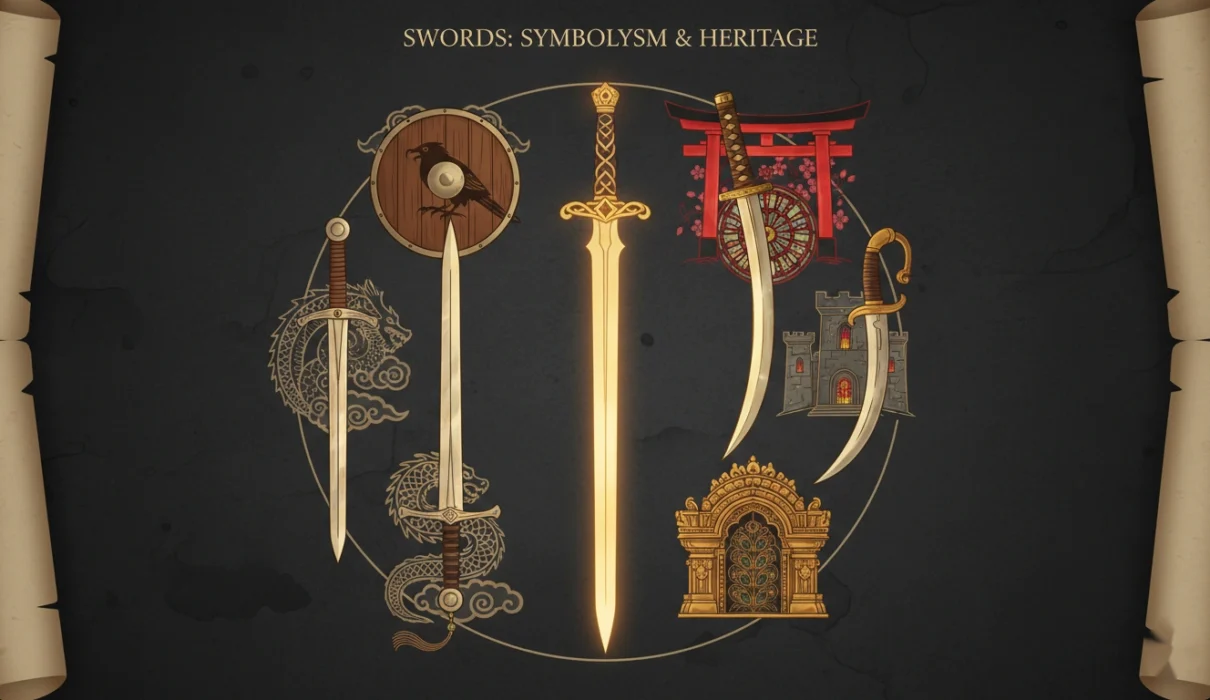
Swords are more than weapons. For thousands of years, they have stood for power, honor, justice, faith, and even love. In many parts of the world, a sword was not just used in battle. It was carried in ceremonies, placed in temples, buried with kings, and passed down in families as a proud heirloom.
From the curved Katana of Japan to the legendary Excalibur of Britain, swords carry deep meaning. Each culture has given the sword its own story and value.
In this detailed guide, we will explore how different civilizations saw the sword and what it symbolized in their traditions.
Why Swords Became Powerful Symbols
Before modern weapons, swords were among the most important tools of war. They required skill to make and skill to use. A well-made sword showed wealth, strength, and status.
Because of this, swords slowly became symbols of:
- Authority and leadership
- Justice and law
- Courage and bravery
- Divine power
- Protection
- Family honor
Now let us see how different cultures understood the meaning of swords.
Symbolism of Swords in Ancient India
In India, swords were closely linked with royalty, warriors, and religion. Many Hindu deities are shown holding swords. The sword often stands for the removal of evil and ignorance.
The goddess Durga is often shown with a sword in her hand. It represents divine power and protection of good over evil. Similarly, the sword in Indian tradition can mean spiritual strength.
Rajput warriors treated their swords with great respect. During festivals like Dussehra, weapons are worshipped in a ritual called Ayudha Puja. This shows that swords were not just tools of war, but sacred objects.
In Sikh culture, the sword is even more important. The Khanda includes a double-edged sword in its center. It stands for divine knowledge, justice, and truth.
Key Meanings in Indian Culture:
- Protection of dharma (righteousness)
- Honor and pride
- Spiritual power
- Warrior identity
Symbolism of Swords in Japanese Culture
In Japan, the sword holds deep spiritual meaning. The famous Katana was not just a weapon. It was believed to hold the soul of the samurai.
Samurai warriors followed a strict code called Bushido. Their sword represented loyalty, discipline, and honor. Losing one’s sword was like losing one’s identity.
There is also a sacred sword in Japanese mythology called Kusanagi-no-Tsurugi. It is one of the three Imperial Regalia of Japan and stands for valor and legitimacy of the emperor.
Key Meanings in Japanese Culture:
- Honor and loyalty
- Discipline and self-control
- Spiritual connection
- Authority of the emperor
Symbolism of Swords in Medieval Europe
In Europe, swords were strongly linked with kings and knights. They symbolized justice, divine right, and noble duty.
One of the most famous examples is Excalibur, the sword of King Arthur. Pulling the sword from the stone showed that he was chosen to be king. Here, the sword symbolized rightful leadership.
Knights were often knighted in ceremonies where a sword touched their shoulders. This act symbolized honor and responsibility.
In Christianity, swords sometimes represent justice. You may see images of angels holding swords as a sign of divine power.
Key Meanings in European Culture:
- Justice and law
- Royal authority
- Divine blessing
- Chivalry and honor
Symbolism of Swords in Islamic History
In Islamic history, swords were symbols of strength and faith. Many early Muslim leaders carried swords that became historic symbols.
One well-known sword is Zulfiqar, associated with Ali ibn Abi Talib. It is often shown with a split blade and represents bravery and justice.
In many Islamic empires, swords were signs of power and leadership. They were also used in ceremonies when rulers were given authority.
Key Meanings in Islamic Culture:
- Courage in faith
- Justice
- Leadership
- Protection of community
Symbolism of Swords in Chinese Culture
In China, swords were connected to wisdom and balance. The straight double-edged sword known as the Jian was called the “Gentleman of Weapons.”
Unlike heavy battlefield weapons, the Jian symbolized skill, intelligence, and moral strength. Many Taoist legends show immortals carrying swords to fight evil spirits.
Swords in Chinese culture were not only tools of war. They were seen as tools of spiritual balance.
Key Meanings in Chinese Culture:
- Wisdom
- Balance
- Moral strength
- Protection from evil
Symbolism of Swords in Norse and Viking Culture
For Vikings, swords were valuable treasures. They were often given names and passed down through generations.
In Norse mythology, the god Odin is connected with weapons and war. Though spears were common, swords still symbolized warrior pride.
A sword in Viking society showed wealth and power. Only successful warriors could afford finely made swords.
Key Meanings in Viking Culture:
- Warrior status
- Family legacy
- Strength
- Honor in battle
Swords as Symbols of Justice
In many cultures, the sword stands for justice. You may see statues of Lady Justice holding a sword. It represents the power to enforce law and punish wrongdoing.
The sword in this sense is not about violence. It is about fairness and order.
Swords in Modern Times
Today, swords are rarely used in war. But their symbolic value remains strong.
- Military officers still carry ceremonial swords.
- Wedding sword traditions are popular in some cultures.
- Swords are used in religious and cultural festivals.
- Families keep swords as heirlooms.
In movies, games, and books, swords still represent heroes and leaders. Even in modern storytelling, a hero with a sword stands for courage and righteousness.
The Spiritual Meaning of Swords
Across many traditions, swords have a deeper meaning:
- Cutting away ignorance
- Fighting inner weakness
- Standing up for truth
- Protecting loved ones
The sword often represents the idea that power must be used with responsibility.
Common Themes Across Cultures
Even though cultures are different, the meaning of swords often overlaps.
| Culture | Main Symbolism |
|---|---|
| India | Dharma, protection, divine power |
| Japan | Honor, loyalty, discipline |
| Europe | Justice, kingship, chivalry |
| Islamic World | Faith, bravery, leadership |
| China | Wisdom, balance |
| Norse | Warrior pride, legacy |
This shows that the sword is one of the most universal symbols in human history.
Final Thoughts
The symbolism of swords in different cultures tells us something important. People do not just create weapons. They create meaning around them.
Whether it is the sacred Katana, the legendary Excalibur, or the historic Zulfiqar, swords represent more than steel and sharp edges.
They stand for honor, justice, courage, and responsibility.
Even today, the sword remains a powerful symbol in culture, religion, art, and storytelling. It reminds us that true strength is not just about power, but about how that power is used.