

 By
By Table of Contents
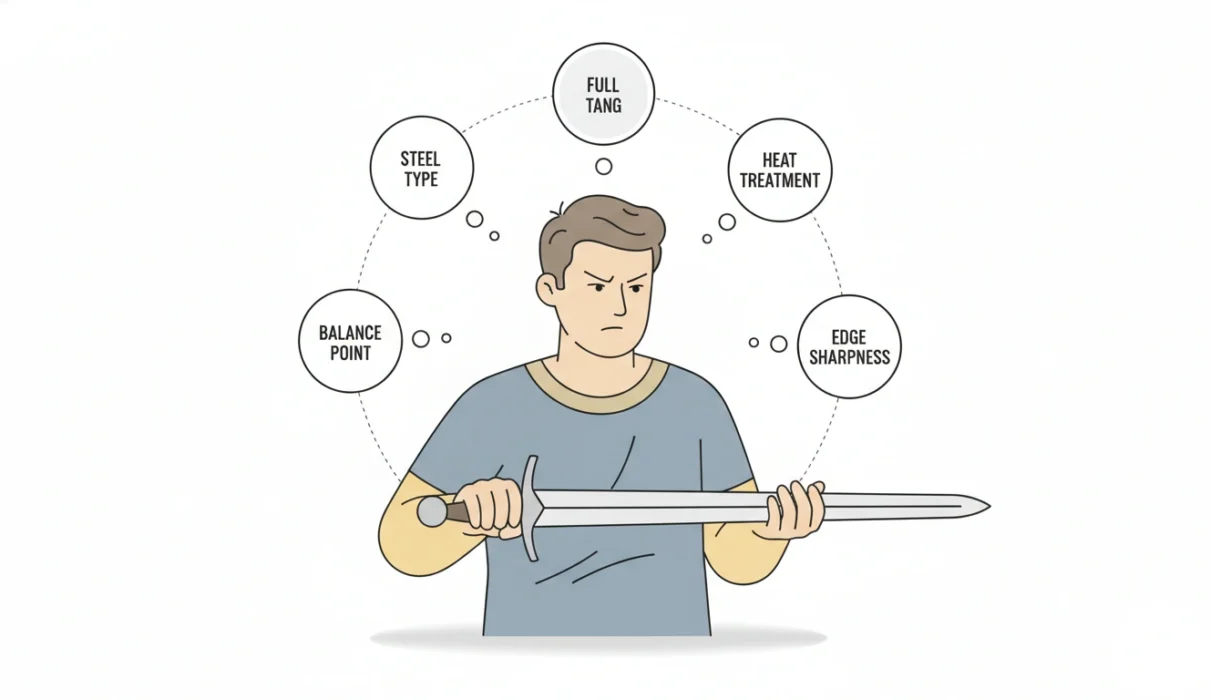
Buying a sword is exciting. Whether you are a collector, a martial arts student, a history lover, or someone buying a ceremonial piece, quality should always come first. A good sword is not just about looks. It is about balance, strength, materials, and craftsmanship.
Many buyers focus only on design and price. But if you want a sword that lasts long and performs well, you need to check several important details before making a decision.
In this guide, you will learn how to check sword quality step by step in simple and practical terms.
1. Understand Your Purpose First
Before checking quality, ask yourself one clear question: Why are you buying the sword?
Your purpose decides what kind of quality matters most.
- Decorative sword – Used for display only.
- Ceremonial sword – Used for weddings or events.
- Practice sword – Used for training or martial arts.
- Functional sword – Used for cutting practice or serious collection.
A decorative sword does not need battle-ready strength. But a functional sword must be made with proper steel, heat treatment, and full tang construction.
Never use a decorative swords for cutting practice. It can break and cause injury.
2. Check the Type of Steel
The steel is the heart of any sword. Poor steel means poor performance.
High Carbon Steel
This is one of the best choices for functional swords. Examples include 1045, 1060, 1095, EN45, and 5160 steel.
High carbon steel offers:
- Good edge retention
- Proper hardness
- Strength and flexibility
Stainless Steel
Stainless steel looks shiny and resists rust, but most stainless steel swords are made for decoration only. They are often too brittle for heavy use.
If you want a real cutting sword, choose high carbon steel over stainless steel.
Damascus Steel
Real Damascus steel has layered patterns created by folding and forging. Be careful. Many cheap swords only have laser-etched patterns that look like Damascus but are not true layered steel.
3. Look at the Tang Construction
The tang is the part of the blade that goes inside the handle. This is one of the most important quality checks.
Full Tang
A full tang sword has the blade steel running fully through the handle. This provides strength and balance.
Rat Tail Tang
This is a thin rod welded to the blade. It is weak and common in decorative swords. Avoid this if you want a functional sword.
If possible, ask the seller about tang construction. A reliable seller will clearly mention it.
4. Check Heat Treatment
Heat treatment makes the blade hard yet flexible. Without proper heat treatment, even good steel can fail.
A well heat-treated sword:
- Holds a sharp edge
- Does not bend easily
- Returns to shape after slight flex
For example, traditional Japanese-style swords like the Katana are differentially hardened. This creates a hard edge and softer spine, which improves durability.
If the seller cannot explain the heat treatment process, be cautious.
5. Examine the Blade Finish
Look closely at the blade.
Things to check:
- Straight alignment
- Even grind on both sides
- No cracks or deep scratches
- No rust spots
The edge should be clean and consistent. If the edge looks uneven, it may be poorly sharpened.
For double-edged swords like the Longsword, both edges should be symmetrical and balanced.
6. Test the Balance
A good sword should feel balanced in your hand.
The balance point is usually a few inches from the guard. If the sword feels too heavy at the tip, it may be poorly designed. If it feels too heavy at the handle, it may lack cutting power.
Historical swords were made for real use. For example, the Talwar has a curved blade and forward balance that helps in slicing motions.
When possible, hold the sword before buying. If buying online, check weight and balance specifications carefully.
7. Check the Handle and Grip
The handle should be:
- Firm and tightly fitted
- Comfortable in hand
- Not loose or shaking
Materials may include wood, leather wrap, cord wrap, or synthetic grip. A loose handle is a serious safety issue.
Also check the guard and pommel. They should not rattle. Everything must feel solid.
8. Inspect the Fittings and Assembly
Look at how the sword is assembled.
Quality swords have:
- Tight guard fitting
- Properly secured pommel
- Even polish and finishing
Cheap swords often have gaps between blade and guard. That is a sign of rushed work.
9. Check Weight and Dimensions
Every sword type has a normal weight range.
For example:
- A functional katana usually weighs around 1.1 to 1.5 kg
- A European longsword may weigh 1.2 to 1.8 kg
If a sword feels extremely heavy, it may not be properly forged. Very heavy swords are often poorly balanced display pieces.
Always compare specifications with historical standards.
10. Research the Seller
Quality does not only depend on the sword. It also depends on the maker or seller.
Before buying:
- Read reviews
- Check customer feedback
- Ask about return policy
- Confirm if the sword is handmade or machine-made
A trustworthy seller will provide clear details about steel type, hardness rating (HRC), tang construction, and heat treatment.
If the description is vague, that is a warning sign.
11. Ask About Hardness Rating
Hardness is measured in HRC (Rockwell Hardness Scale).
For functional swords:
- Edge hardness often ranges between 50–60 HRC
- Too soft means dull edge
- Too hard means brittle blade
Balanced hardness is important. That balance gives strength and flexibility.
12. Look for Proper Scabbard Quality
A good sword often comes with a proper scabbard.
Check:
- Fit of the blade inside
- Quality of wood or leather
- Proper stitching
A loose scabbard can damage the blade over time.
13. Avoid Common Red Flags
Be careful if:
- The price is extremely low for a “battle ready” sword
- No steel type is mentioned
- No tang information is provided
- The sword has fantasy shapes with unrealistic thickness
- The blade is made from cheap stainless steel but marketed as combat ready
Quality swords require skilled labor and proper materials. They cannot be extremely cheap.
14. Understand Legal Rules
Before buying, check local laws in your area regarding sword ownership. Laws may differ depending on state or country.
Always buy responsibly and store safely.
15. Decorative vs Functional: Know the Difference
Many people make the mistake of buying a decorative sword and assuming it can be used for cutting.
Decorative swords:
- Often stainless steel
- Rat tail tang
- Made for wall display
Functional swords:
- High carbon steel
- Full tang
- Proper heat treatment
- Designed for performance
Always confirm this difference before paying.
16. Consider Craftsmanship Over Fancy Design
A simple sword made with proper steel and good balance is better than a flashy sword with poor construction.
Focus on:
- Steel quality
- Tang structure
- Heat treatment
- Balance
- Tight fittings
Design comes after strength.
17. If Buying Online
When buying online:
- Ask for close-up blade photos
- Ask for tang details
- Check exact measurements
- Confirm return policy
- Ask about warranty
Do not rely only on product images. Many images are edited.
Final Thoughts
Buying a sword is not just about choosing a beautiful piece. It is about understanding quality, safety, and purpose.
A good sword should have:
- High carbon steel
- Proper heat treatment
- Full tang construction
- Balanced weight
- Strong handle assembly
If you carefully check these points, you will avoid common mistakes and choose a sword that lasts for years.
Frequently Asked Questions
How can I tell if a sword is battle ready?
A battle ready sword usually has high carbon steel, full tang construction, and proper heat treatment. The seller should clearly mention steel type, hardness rating (HRC), and tang details. If this information is missing, it is likely not made for real use.
Is stainless steel good for functional swords?
In most cases, no. Stainless steel is good for decorative swords because it resists rust and looks shiny. But it is often too brittle for heavy cutting or training. For functional use, high carbon steel is a better choice.
What is full tang and why is it important?
Full tang means the blade steel runs fully through the handle. This makes the sword stronger, more stable, and safer to use. A sword with a thin welded rod inside the handle is weaker and should not be used for cutting practice.
What hardness rating is best for a sword?
Most functional swords have a hardness rating between 50–60 HRC. If it is too soft, the edge will dull quickly. If it is too hard, the blade may become brittle and crack. A balanced hardness gives both strength and flexibility.
Can I use a decorative sword for cutting practice?
No. Decorative swords are made for display only. They usually have weaker tang construction and softer materials. Using them for cutting can cause the blade to break and lead to serious injury.
