

 By
By Table of Contents
When buying a sword, many people focus on how it looks. The shape of the blade, the handle design, or the historical style often get the most attention. But one small detail matters more than most people realize. That detail is HRC.
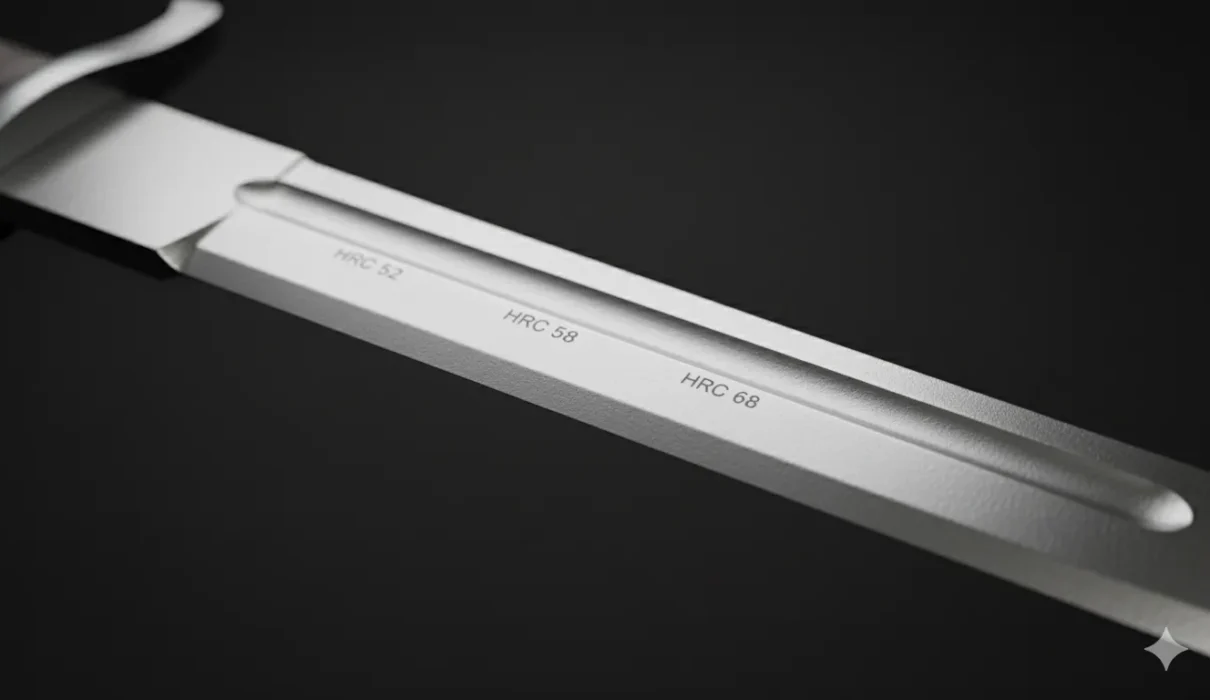
HRC is not decoration. It is not marketing. It directly affects how sharp a sword can be, how long it stays sharp, and how likely it is to bend, chip, or break. Whether you are buying a katana, a European longsword, or a modern tactical blade, understanding HRC helps you avoid costly mistakes.
This guide explains what HRC means, how it is measured, why it matters so much, and how to choose the right HRC for your needs in 2025.
What Is HRC?
HRC stands for Hardness Rockwell C. It is a standard scale used to measure how hard steel is. In simple terms, it tells you how resistant the steel is to dents and damage.
Steel hardness plays a huge role in blade performance. A blade that is too soft will lose its edge quickly. A blade that is too hard may chip or snap under stress. HRC helps measure where a blade falls on that scale.
Most functional swords fall between 45 and 62 HRC.
- Below this range, the sword is usually decorative only
- Above this range, the blade is often too brittle for real use
How HRC Is Measured
The Rockwell C test is used specifically for hardened steel.
During the test, a machine presses a diamond tipped cone into the surface of the steel with a fixed force of 150 kilograms. The depth of the indentation is then measured.
- A shallow indentation means harder steel and a higher HRC
- A deeper indentation means softer steel and a lower HRC
This test does not guess. It gives a repeatable and accurate number, which is why HRC is trusted across the knife and sword industry.
Why HRC Matters in Sword Performance
HRC is not about choosing the highest number. It is about finding balance. Every sword must balance three key traits: edge retention, toughness, and ease of sharpening.
Edge Retention
Harder steel holds a sharp edge longer.
When a blade has a higher HRC, the edge resists rolling and dulling during cuts. This allows the sword to stay sharp after repeated use. Blades in the 58 to 60 HRC range are often preferred for clean cutting practice.
However, edge retention alone does not make a good sword.
Toughness and Durability
Toughness is the ability of a blade to absorb impact without breaking.
Softer steel bends slightly under stress. This bending helps the blade survive bad cuts, angled strikes, or contact with harder objects. Blades in the 50 to 54 HRC range are often more forgiving.
A sword that is too hard may look perfect until it hits something solid. At that point, instead of bending, it can chip or crack.
Ease of Sharpening
Harder steel is harder to sharpen.
High HRC blades often need diamond or ceramic stones. Softer blades can be sharpened quickly using basic stones. For many users, easy maintenance matters more than extreme edge retention.
The Trade Off Between Hardness and Brittleness
This is the core truth of sword making.
- Increase hardness and you gain sharpness
- Increase hardness too much and you lose toughness
A sword at 62 HRC can be razor sharp, but it can also fail suddenly if misused. A sword at 48 HRC may survive abuse, but it will not hold a sharp edge for long.
Good sword makers choose an HRC that fits the sword’s purpose, not the highest possible number.
HRC by Sword Type
Different swords are built for different tasks. Because of this, their ideal HRC ranges are not the same.
Katana
Traditional Japanese swords are famous for differential hardening.
The blade is coated with clay before quenching. The edge cools faster than the spine, creating two hardness zones.
- Edge: around 60 to 62 HRC
- Spine: around 40 to 45 HRC
This design gives excellent cutting ability while reducing the risk of full blade failure. The softer spine absorbs shock and protects the hard edge.
European Longswords and Arming Swords
European swords are usually through hardened, meaning the hardness is even across the blade.
- Typical range: 50 to 54 HRC
These swords were built for battle conditions. They needed to survive blade contact, armor strikes, and heavy use. Flexibility mattered more than extreme sharpness.
A well made longsword can flex and return to true without damage.
Training Swords and Feders
Practice swords used in HEMA prioritize safety.
- Typical range: 48 to 52 HRC
Lower hardness allows the blade to bend during thrusts. This reduces injury risk and prevents dangerous snapping.
Common Sword Steels and Their HRC Range
Steel choice affects how hard a blade can be made safely.
1045 Carbon Steel
- Typical HRC: 45 to 50
- Use: Budget swords and light practice
Easy to work with but does not hold an edge well.
1060 and 1065 Carbon Steel
- Typical HRC: 52 to 56
- Use: Well balanced functional swords
Often considered a good middle ground.
1095 Carbon Steel
- Typical HRC: 58 to 62
- Use: High end cutting swords
Excellent sharpness but requires skilled heat treatment.
5160 Spring Steel
- Typical HRC: 50 to 55
- Use: Tough European swords
Known for impact resistance and flexibility.
T10 Tool Steel
- Typical HRC: 60+
- Use: Modern katana blades
Very sharp but unforgiving if poorly treated.
Why Heat Treatment Matters More Than the Number
Two swords with the same HRC can behave very differently.
Heat treatment controls grain structure, internal stress, and flexibility. Proper tempering reduces brittleness after hardening. Without good heat treatment, even a perfect HRC number means nothing.
This is why trusted makers always explain their heat treat process.
Choosing the Right HRC for Your Needs
For Cutting Practice
If you plan to cut soft targets like tatami mats or bamboo, look for 58 to 60 HRC. This range offers clean cuts and good edge life.
For Durability and General Use
If you want a sword that can handle mistakes, choose 52 to 54 HRC. It will survive better and still perform well.
For Collectors
If the sword is for display, HRC matters less. However, avoid sellers who hide or avoid sharing hardness details.
Common Myths About HRC
Higher HRC Always Means Better
This is false. A sword that is too hard is often worse than one that is slightly softer.
One Perfect HRC Exists
There is no single best number. The right HRC depends on blade length, steel type, and use.
HRC Replaces Skill
HRC cannot fix poor design, bad steel, or weak heat treatment.
Faq’s
What is a good HRC for a sword?
A good HRC for most functional swords is between 50 and 58. This range gives a balance of sharpness and strength without making the blade too brittle.
Is higher HRC always better for swords?
No. Higher HRC means better edge retention, but it also makes the blade more brittle. Very hard swords can chip or break if used incorrectly.
What HRC is best for cutting practice?
For cutting targets like tatami mats or bamboo, an HRC of around 58 to 60 works well. It keeps the edge sharp for longer cuts.
Why do katanas have different HRC on the blade and spine?
Katanas use differential hardening. The edge is hard for sharpness, while the spine is softer to absorb impact and prevent breaking.
Can a sword be too hard to use safely?
Yes. A sword that is too hard, especially a long blade above 60 HRC, can crack or snap on impact. Proper tempering and correct HRC are important for safety.
Final Thoughts
HRC is not just a technical detail. It is the balance between sharpness and strength.
A sword should stay sharp, but it should also survive use. Understanding HRC helps you choose a blade that fits your needs and avoids disappointment.
When buying a sword, always look beyond looks. Ask about hardness, steel type, and heat treatment. A well balanced sword will always outperform one that chases extreme numbers.
In the end, the best sword is not the hardest one. It is the one that stays sharp and stays in one piece.
